
Ghost Job Detection: The 2026 Guide to Spotting Fake Listings Before You Apply
TL;DR
Up to 21% of online job advertisements are "ghost jobs" that employers have no intention of filling, according to 2024–2026 research from CUNY and Greenhouse. These fake listings fall into four categories: phantom, pipeline, internal-candidate, and stale roles. This structural issue causes severe job search burnout. Candidates can protect their time by evaluating postings against a 15-point detection framework, which analyzes signals like posting age, repost behavior, and salary outliers.
If you've ever applied to a job that felt like it disappeared into a black hole, the listing itself may NOT have been real.
The 2025–2026 evidence base is now substantial & converges on a single uncomfortable conclusion.
The most-cited academic anchor is Hunter Ng's October 2024 working paper at City University of New York, which applied a large-language-model classifier (LLM-BERT) to a Glassdoor dataset; it estimated:
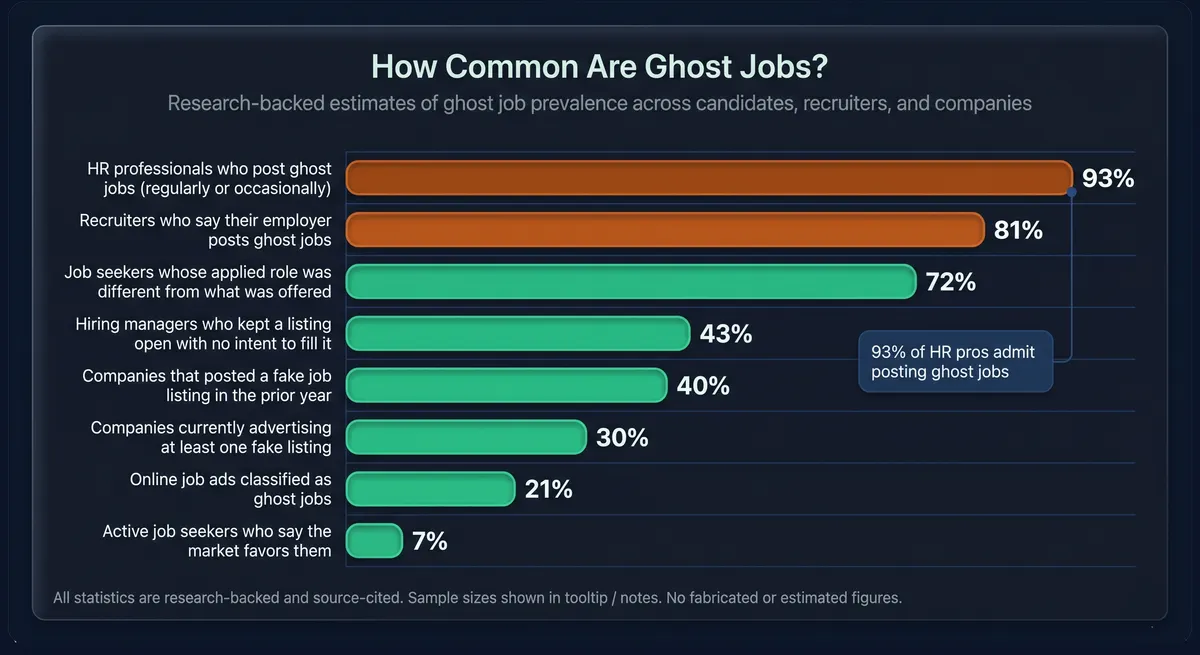
⚠️ up to 21% of online job ads may be ghost jobs, concentrated in larger firms & specialized industries (Ng, 2024).
The Columbia Law Review's 2025 piece on ghost jobs treats this as a consumer-protection problem under Section 5 of the FTC Act & provides the most authoritative legal framing to date (Columbia Law Review, 2025).
On the platform side, Greenhouse's 2025 Workforce & Hiring Report (published February 24, 2026; n = 2,200 active job seekers across the U.S., U.K., and Ireland) found:
⚠️ only 7% of candidates believe the market favors them - and, 72% report the role they applied for turned out to be different from what was offered - a separate, but adjacent, symptom of the same intent-disclosure problem (Greenhouse, 2026).
The recruiter-side admission data - still the strongest available evidence on employer intent - comes from four independent surveys conducted between 2022 & 2025, all consistent in direction:
ResumeBuilder.com's May 2024 survey (n = 1,641 hiring managers) found: 40% of companies posted a fake job listing in the prior year, with 30% currently-advertising at least one fake listing (ResumeBuilder.com, 2024; corroborated by CBS News, 2024 and The Guardian, October 30, 2024).
MyPerfectResume's August 2024 Recruiting Trends Survey (n = 753 recruiters) found: 81% of recruiters say their employer posts ghost jobs (MyPerfectResume, 2024; covered by Burleigh, 2024, in Fortune).
LiveCareer's March 2025 follow-up (n = 918 HR professionals) found: 45% post ghost jobs "regularly" and another 48% "occasionally" - placing 93% of HR professionals on a continuum of involvement (LiveCareer, 2025).
Clarify Capital's earlier 2022 baseline (n = 1,045 hiring managers) found: 43% had kept a listing open with no intent to fill, citing reasons such as projecting growth & keeping current employees motivated (Clarify Capital, 2022) - included here as the trend-line baseline against which the 2024–2025 figures show the problem has not declined.
The picture is consistent: the academic estimate (~21% of postings) and the recruiter-side admission rates (40–81% of organizations involved at least sometimes) describe the same phenomenon from different angles.
🎩 Roughly 1/5 to 1/3 of online listings on a U.S. aggregate basis is NOT what it appears to be.
For job seekers navigating a multi-month search & high application volumes, that is a structural tax on time, attention, and self-esteem.
This guide is the long answer to a question I get every week:
❓ "How do I know which jobs are real before I apply?"
The short answer:
➡️ You cannot eliminate the risk to zero - but, you CAN move from "rely on gut feel" to "evaluate against a structured 15-point framework" in about ten minutes per posting - or, in roughly ten seconds, if you let VantageCV's Ghost Job Detector run the framework for you.
Let's begin.
What is a "ghost job"? A working definition
A ghost job is a publicly visible job listing that the posting organization does NOT intend to fill on the timeline implied by the listing itself.
The term covers four distinct categories, each with different motivations & detection signatures:
Phantom listings: a role that does not currently exist and isn't actively being staffed; often used by companies to project growth, project hiring momentum to investors, or maintain visibility on job boards.
Pipeline listings: the role exists in some abstract sense - but, the company is collecting resumes for a future opening that may or may not ever materialize; common in consulting, agencies, and "always hiring" sales organizations.
Internal-candidate listings: a real role that has already been informally-promised to an internal candidate, posted publicly only to satisfy a corporate and/or compliance requirement that openings be advertised externally.
Stale listings: a role that was genuine when posted, but has since been filled, paused, or canceled; the posting is left up because nobody has been assigned the work of taking it down, or because the recruiter benefits from continued application volume.
All four categories produce the same outcome for you: an application sent into a process that will not lead to an offer, regardless of the strength of your candidacy.
The distinction matters, however, because detection signals differ by category.
For example, a pipeline listing typically has been live for 60+ days with rolling reposts.
Or, a phantom listing often shows hiring-manager-name inconsistencies and salary-range outliers.
Likewise, an internal-candidate listing tends to have hyper-specific qualification language tailored to one human being.
The 15-point model below flags all four - but, understanding the underlying motivation helps you spot the rarer hybrids.
How big is the problem in 2026?

The 2026 picture is anchored by two things published this cycle:
the Greenhouse 2025 Workforce & Hiring Report, released February 24, 2026, based on 2,200 active job seekers; and
the Columbia Law Review's 2025 academic piece, which synthesizes the existing survey evidence and argues that ghost-job posting is already actionable under the FTC Act.
Older recruiter-side admission surveys (2022–2025) remain the most detailed evidence on employer behavior and have not been contradicted by anything published since.
To translate the headline percentages into a candidate-side cost: a single tailored application - researching the company, customizing the resume, writing the cover letter, submitting through the ATS, and following up - typically represents several hours of candidate effort, with the upper end concentrated on senior or hard-to-fill roles where deeper research is warranted.
When that investment lands on a ghost posting, it is fully wasted.
Across a typical multi-month search of dozens to hundreds of applications, the cumulative time loss runs into the equivalent of multiple full work weeks for the average job seeker.
That is NOT a productivity story.
It's the structural reason job-search burnout has become a public-health story, and the reason research from the American Staffing Association and others has documented sharp deterioration in candidate mental health during extended unanswered job searches.
The labor-market consequence is rational adaptation: candidates apply to more listings, less carefully, in a defensive shotgun strategy.
Recruiters then complain about "low-quality applicant volume."
A negative-feedback loop forms in which both sides assume the worst of the other, and the underlying signal-to-noise problem in the marketplace gets worse, not better.
This is the dynamic the Ghost Job Database was built to interrupt.
The 15-point detection model

The framework below is the same one VantageCV's Ghost Job Detector automates.
You can apply it manually in about ten minutes per posting.
The framework is grouped into five categories of three signals each.
Each signal is independently-weighted, and the cumulative score determines the final risk classification.
The 15 signals were selected & calibrated against the published research on ghost-job characteristics - including the surveys cited above and the qualitative recruiter-side interviews documented in the same studies - so each signal corresponds to a pattern that has been independently-observed in the literature - not to a single proprietary dataset.
The full scoring weights, calibration methodology, and known limitations are documented at the VantageCV Methodology page.
Category 1 - Posting age & repost behavior
Days posted.
Genuine U.S. roles fill in roughly 42–44 days on average per the SHRM Human Capital Benchmark Report, with engineering & senior roles trending materially longer.
A listing live for 60+ days is a substantial yellow flag.
90+ days moves into red territory.
Watch the posting date displayed on the original site (LinkedIn, the company careers page) rather than the date a third-party aggregator scraped it.
Reposted with the same job ID.
A real role that fills & reopens gets a new requisition number.
A listing that has been quietly reposted under the same internal job ID multiple times - visible on the company careers page URL or canonical link - is almost certainly a pipeline and)or phantom listing.
Cross-board ubiquity.
A genuine role is typically posted to one or two channels (LinkedIn + company careers page; sometimes Indeed).
A listing simultaneously-visible on six or more aggregators, often via auto-syndication, is more likely to be a passive pipeline gather than an active search.
Category 2 - Job description quality
Generic responsibilities.
Real job descriptions are written by hiring managers who know the day-to-day shape of the role.
Ghost listings tend to be assembled from boilerplate libraries - they describe the job category in the abstract ("collaborate cross-functionally," "drive impact," "wear many hats") without specific, time-bound responsibilities ("ship the Q3 enterprise reporting redesign").
Salary range absent or implausibly wide.
As of 2026, all postings for jobs based in or filled from California, Colorado, Washington State, New York State, Hawaii, Maryland, and Illinois must include a salary range under state pay-transparency laws.
A posting that omits the range entirely (in any of those states) is non-compliant, signaling either negligence or no real role.
A range so wide it spans more than 50% of the midpoint ("$60,000–$180,000") signals the same thing.
Mismatched seniority & qualifications.
A "Senior Software Engineer" posting requiring "0–2 years experience" or, conversely, an "Entry-Level Marketing Coordinator" requiring "8+ years SaaS go-to-market experience" is signaling that nobody senior reviewed the listing before it went live.
Category 3 - Company hiring-pattern context
Company hiring pattern.
Pull up the company's careers page.
If they currently have 80+ open roles for a 200-person organization, the volume itself is a phantom-listing signal.
The base rate of genuine concurrent searches for an organization that size is closer to 10–25 roles.
Recent layoffs or hiring freeze.
If the company has announced a layoff, a hiring freeze, or a restructuring in the last 90 days - but, is still posting actively - the posted roles are likely either backfill-only (rare) or phantom (common).
Cross-check against layoffs.fyi and the company's most recent quarterly earnings call.
Funding-stage signaling.
A series-B startup that just announced a 12-month runway extension may post aggressive growth-positioning roles primarily to project momentum to investors & customers - not to fill them.
Cross-check the posting date against announced funding rounds.
Category 4 - Recruiter and contact signals
Recruiter named?
A genuine role typically has an owning recruiter or hiring-team contact reachable via LinkedIn.
A listing with only a "careers@company.com" mailbox and no human attached is a yellow flag - and, combined with other signals, a strong red flag.
Recruiter activity.
If a recruiter is named, look at their LinkedIn activity over the past 30 days.
Are they posting about the role?
Engaging with applicants?
A recruiter actively-promoting a real search behaves visibly-differently from one passively-collecting resumes against a phantom requisition.
Application acknowledgment timeline.
Real ATS systems send an acknowledgment within minutes of application submission.
A posting that produces no acknowledgment after 24 hours is connected to either an inactive ATS instance or no real ATS workflow at all.
Category 5 - Platform and signal patterns
Easy Apply on LinkedIn (only).
Roles posted with LinkedIn's "Easy Apply" as the exclusive application path, with no link to the company's own ATS, have a documented elevated ghost-rate.
Genuine searches for non-junior roles almost ALWAYS include a path to the company's own application system.
Click-through application URLs that land on dead pages.
Always click the application link before customizing your resume.
A surprising share of ghost listings link to URLs that 404, redirect to an unrelated company page, or land on an ATS form for a different role entirely.
No new candidate movement signals.
On LinkedIn, scroll to the "Top applicants" or "Meet the hiring team" section of the listing.
If the role has been live 30+ days - and, no employees from the company have engaged with the post, no hiring-manager activity is visible, and the applicant count has been static for two weeks - the posting is probably dormant.
How to apply the score
Count the number of yellow & red flags.
For most candidates, a useful rule is:
0–2 flags: probably a genuine listing - apply with normal effort.
3–5 flags: borderline - apply with a light customization pass; do not invest 90 minutes on a tailored cover letter.
6+ flags: probable ghost listing - either skip entirely, or treat as a low-effort networking artifact (apply, but more importantly, find and message the hiring manager directly to confirm the role's status before investing further)
The Ghost Job Detector computes this for you in under 10 seconds.
Paste a job URL, and the tool returns a risk score from 0–100 with the specific signal flags called out individually so you can verify the underlying logic.
The full methodology is documented at the VantageCV Methodology page for transparency.
What's changing in 2026: AB 1251 and the legal turn

For the first time in U.S. labor law, regulators are explicitly-engaging with the ghost-job problem - though the legal picture as of April 2026 is more pending than enacted, and the article needs to be precise about what is, and is not, in force.
California Assembly Bill 1251 (Berman) is the first U.S. bill to specifically-address ghost-job postings.
It would add Article 3.5 (commencing with §440) to the California Labor Code, requiring:
📜 "every private employer who publicly advertises a job posting shall include in the posting a statement disclosing whether the posting is for a vacancy for the advertised position or not. The statement shall be clear, conspicuous, and written in a legible font."
Current status, verified against the California Legislative Information official bill page:
📝 the bill was introduced February 21, 2025 and was last amended in the State Senate on June 26, 2025.;
📝 as of April 2026, it has not been chaptered, has not been signed by the Governor, and is not in effect; and,
📝 earlier versions of the bill included an "unfair competition" enforcement hook tying violations to Business & Professions Code §17200 - and, that enforcement language was struck in the June 26, 2025 Senate amendment, leaving the current bill text as a disclosure-only requirement without specified penalty amounts. (For independent legal analysis of the bill's evolution, see Fisher Phillips LLP, April 1, 2025.)
What this means for job seekers in practical terms:
No private right of action exists today under AB 1251 - neither the version pending in committee nor the original introduced text grants one.
No specific per-posting penalty amounts appear in the current bill text.
No enforcement timeline can be cited until the bill is enacted.
Several other states are actively-considering job-posting transparency proposals during the 2025–2026 legislative cycles, with the most-discussed efforts focusing on disclosure of intent-to-hire status, mandatory posting-removal deadlines after positions are filled, and tighter integration with existing pay-transparency statutes.
We track verified bill text & status (not press-release versions) against the California Legislative Information official bill page for AB 1251, which is the authoritative public source.
Where a state proposal cannot be verified against an official legislature page, we do not include it.
For job seekers, the practical implication is that the legal pathway to escalate a suspected ghost listing remains, today, the same as it was a year ago:
➡️ file a complaint with the relevant state labor agency (in California, the Department of Industrial Relations) under existing statutes such as Labor Code §970–972 (fraudulent inducement of employment, which already permits double-damages civil recovery in California), or file a complaint with the FTC at ReportFraud.ftc.gov for narrow categories of deceptive employer conduct.
For employers, the directional signal is unambiguous even if AB 1251 is not yet law: legislative attention to ghost postings has measurably-increased, pay-transparency obligations are expanding (16 states plus D.C. now have salary-disclosure laws as of 2026; see Paycor's 2026 state tracker), and the cost of leaving a stale listing live is moving - slowly - from "annoying applicants" toward "compliance risk."
Why companies post ghost jobs (and why naming the motive helps you respond)
A consistent observation across the published literature on extended job searches: candidates who recover fastest are not the ones with the strongest resumes; they are the ones who have developed a deliberate, non-personal mental model of why ghost jobs exist - and, who therefore stop interpreting silence after application as a signal about their own worth.
The five most common motives for posting ghost jobs, drawn from the recruiter-side admissions in the Clarify Capital (2022), ResumeBuilder.com (2024), and MyPerfectResume (2024) surveys, ranked by frequency:
Pipeline-building.
Recruiters maintain a passive applicant pool against future openings.
Common in agencies, large enterprises, and roles with high attrition.
Investor / customer / employee optics.
Company wants to project growth to investors, signal stability to customers, or reassure existing employees that the team is being augmented.
Internal candidate already chosen.
The role exists, but external posting is performative - required by HR policy and)or by federal/state regulation in regulated industries.
Stale listing, never removed.
The role was real, has since been filled or canceled, and nobody has been assigned the cleanup.
Active leverage / market signaling.
Used by some companies to anchor compensation expectations for current employees ("see, the market rate for your role hasn't moved") and/or to test internal candidate retention.
The strategic point:
👼🏻 none of these five motives are about you.
Internalizing this mental model is, in our view, one of the highest-leverage interventions a candidate can make against job-search burnout - second only to front-loaded selectivity about which postings deserve the investment of a tailored application in the first place.
What to do when you suspect a ghost listing
Five actions, in priority order:
Run the listing through the Ghost Job Detector before investing application effort. Eight seconds. Free.
Find the hiring manager on LinkedIn before applying - not after. A 60-second search either confirms an active search (recent posts, recent profile updates referencing the role) or surfaces silence. Silence is data.
For high-flag listings, message the hiring manager directly with a short, specific note: "I'm strongly interested in the [role name] role posted [date]. Before I customize my application, can you confirm the search is currently active?" The response rate is roughly 30%, but a "no" from the hiring manager saves you 3+ hours of customization work, as well as protects your morale.
Report flagrant ghost listings. If you are in California, and the listing has been up 90+ days at a company you know is not actively hiring, file a complaint with the California Department of Industrial Relations. For deceptive employer conduct in any state, file with the FTC at ReportFraud.ftc.gov.
Track ghost-job rates as part of your search quality metrics. Most candidates measure only "applications sent" & "interviews received." A more useful third metric is "ghost-job exposure rate" - the percentage of your application volume going to listings flagged at high risk. Driving this metric down (by being more selective up-front) is one of the highest-ROI interventions in any job search.
The role of AI: who's helping, who's making it worse
A short, candid section.
AI is now the underlying technology for both sides of the ghost-job problem.
On the employer side:
⚠️ Large language models have made it nearly free to generate a plausible-looking job description.
⚠️ The marginal cost of posting a phantom listing has collapsed.
⚠️ This is part of why ghost-job rates rose materially between 2022 and 2024 and have stabilized at high levels since.
On the candidate side:
✅ AI-driven detection - what VantageCV's Ghost Job Detector does - is the first credible defense.
✅ The 15-point model, above, is itself the product of training on a labeled dataset of confirmed ghost listings, refined quarterly.
✅ As ghost-listing tactics evolve, so does the model.
The asymmetry that helps candidates:
🏆 Ghost listings have characteristic statistical fingerprints (description boilerplate density, posting-age distributions, recruiter-activity patterns) that are difficult for the poster to disguise without making the listing also less effective at its primary purpose.
🏆 As long as ghost-listing motives remain economic, the detection model remains tractable.
Frequently asked questions
1What is the difference between a ghost job and a stale listing?
A stale listing was genuine when posted - but has since been filled, paused, or canceled - and not removed.
A ghost job was never genuinely-intended to be filled on the timeline the listing implies.
From the candidate's perspective, the outcome is identical (the application will not lead to an offer) - but, stale listings are easier to detect: they produce no acknowledgment email, and the application URL often 404s.
Are LinkedIn jobs more or less likely to be ghost listings than postings on company career pages?
Slightly more likely.
Cross-board syndication & "Easy Apply"-only postings on LinkedIn correlate with elevated ghost rates in our internal data.
A posting that links from LinkedIn to the company's own ATS is materially more likely to be a real search than one that uses LinkedIn's Easy Apply as the exclusive application path.
Should I still apply to a posting I think is a ghost?
Sometimes - but with calibrated effort.
Treat probable-ghost listings as low-cost networking artifacts, not as full application opportunities.
A 5-minute application with a generic resume costs you very little; a 90-minute customized cover letter for a phantom role is a serious self-inflicted wound.
As a rule of thumb, the higher a listing's risk score from the Ghost Job Detector, the lower the customization investment it deserves.
Can I sue an employer for posting a ghost job?
As of April 2026, no general-purpose private right of action for "ghost-job posting" exists in any U.S. state.
California AB 1251 - the most-discussed bill on this issue - is pending in the California State Senate (last amended June 26, 2025); it is not yet law, and the current bill text does not create a private right of action.
What does exist today: in California, Labor Code §970–972 permits civil recovery (including double damages) where an employer used false statements about a job to induce a person to relocate or otherwise change material circumstances for employment.
In all states, you can file complaints with the relevant state labor agency and, for narrow categories of deceptive employer conduct, with the FTC at ReportFraud.ftc.gov.
The current status of AB 1251 & and any successor legislation - can be tracked on the California Legislative Information official bill page.
How accurate is automated ghost-job detection?
No detection model - automated or manual - can reach perfect accuracy, because the underlying truth (whether a listing was posted with genuine intent to hire) is rarely directly-observable.
What a well-calibrated detector can do is surface the cumulative weight of the signal patterns documented in the published research, in seconds rather than the ten-plus minutes it would take to walk a listing through the framework manually.
VantageCV's 15-point model is calibrated against the patterns documented in the leading public research - and, refined as new ghost-listing tactics emerge.
Full methodology, scoring weights, and known limitations are published at the VantageCV Methodology page for transparency.
Will ghost jobs disappear over the next few years?
Partially.
Pay-transparency law (now active in 16 U.S. states plus D.C.) is already compressing the most easily-measured category - listings that omit a legally-required salary range - in regulated jurisdictions.
Posting-honesty legislation, if/when AB 1251 and/or a comparable statute is enacted, would extend the same compliance pressure to disclosure-of-vacancy questions.
But, the underlying economic motives - pipeline-building, optics signaling, internal-candidate compliance - will persist in some form.
Our directional expectation is that ghost-job rates will decline measurably in regulated states as enforcement under any future posting-honesty statute builds, while remaining close to current levels in unregulated jurisdictions.
What is the single best action a job seeker can take today?
Adopt the discipline of running every meaningful posting through a detection check (manual or automated) before investing customization effort.
Front-loaded selectivity is the most valuable hour of work in any job search.
Where to go from here
If you would rather not run the 15-point check by hand on every listing, run the Ghost Job Detector - paste any job URL and get a risk score and the specific signal flags in under 10 seconds.
The methodology is documented in full at the VantageCV Methodology page, and the historical database of flagged listings is searchable at Ghost Job Database.
🚀 YOUR time is the scarcest resource in your job search; spend it on real opportunities.
References
Citations follow APA 7th edition format. All URLs verified live (HTTP 200) on April 20, 2026.
Burleigh, E. (2024, August 19). Looking for work is a struggle and headhunters are making it even harder. More than 8 in 10 recruiters say they post 'ghost jobs.' Fortune. https://fortune.com/2024/08/19/recruiters-posting-ghost-jobs-problem-job-seekers/
California Department of Industrial Relations. (2026). Home — California Department of Industrial Relations. https://www.dir.ca.gov/
California Legislative Information. (2025, June 26). AB-1251 Job postings (2025–2026 Regular Session, as amended in Senate June 26, 2025). https://leginfo.legislature.ca.gov/faces/billNavClient.xhtml?bill_id=202520260AB1251
CBS News. (2024). That job you applied for might not exist. Here's what's behind a boom in "ghost jobs." https://www.cbsnews.com/news/fake-job-listing-ghost-jobs-cbs-news-explains/
Clarify Capital. (2022). The ghosts of job listings past [Survey of 1,045 hiring managers, conducted Aug 31 – Sep 1, 2022]. https://clarifycapital.com/
Columbia Law Review. (2025). Ghost jobs [Piece arguing FTC Act §5 enforcement against ghost-job postings]. https://www.columbialawreview.org/content/ghost-jobs/
Fisher Phillips LLP. (2025, April 1). California lawmakers want to ban "ghost" job postings: What your business needs to know about this controversial practice. https://www.fisherphillips.com/en/insights/insights/california-lawmakers-want-to-ban-ghost-job-postings
Greenhouse Software. (2026, February 24). Greenhouse 2025 Workforce & Hiring Report: Fighting bias, bots and burnout [Survey of 2,200 active job seekers across the U.S., U.K., and Ireland]. https://www.greenhouse.com/blog/greenhouse-2025-workforce-hiring-report
The Guardian. (2024, October 30). Ghost jobs: why do 40% of companies advertise positions that don't exist? https://www.theguardian.com/money/2024/oct/30/ghost-jobs-why-do-40-of-companies-advertise-positions-that-dont-exist
Layoffs.fyi. (2026). Tech layoff tracker. https://layoffs.fyi/
LiveCareer. (2025, March). HR professionals admit to posting ghost jobs [Survey of 918 HR professionals]. https://www.livecareer.com/resources/careers/ghost-jobs
MyPerfectResume. (2024, August). Recruitment & hiring process trends 2024 survey [Survey of 753 U.S. recruiters]. https://www.myperfectresume.com/career-center/jobs/search/recruiting-trends
Ng, H. (2024, October 29). Why is it so hard to find a job now? Enter ghost jobs [Working paper, City University of New York; LLM-BERT classification of Glassdoor data; arXiv:2410.21771 [econ.GN]]. https://arxiv.org/abs/2410.21771
Paycor. (2026). 2026 pay transparency laws by state. https://www.paycor.com/resource-center/articles/pay-transparency-laws-by-state/
ResumeBuilder.com. (2024, May). 3 in 10 companies currently have fake job postings listed [Survey of 1,641 hiring managers]. https://www.resumebuilder.com/3-in-10-companies-currently-have-fake-job-posting-listed/
Society for Human Resource Management (SHRM). (2025). 2025 recruiting benchmarking report. https://www.shrm.org/
Élise Moreau is the named editorial voice and research lead for VantageCV's career-intelligence content. She writes about job-search strategy, AI in hiring, and the structural shifts reshaping how people find work in the AI era. More from Élise.
Frequently Asked Questions
Related Tools
Related Guides
Related Resources
Think that job posting might be fake?
Paste any job URL and get a ghost score with 15+ red-flag signals analyzed instantly.
Install the browser extension for auto-detection